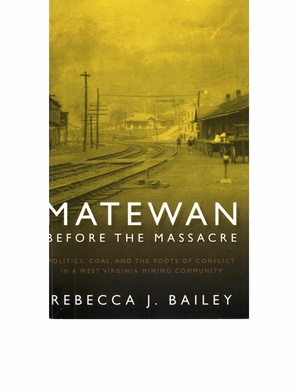
Matewan Before the Massacre

Matewan Before the Massacre on Google Books, or view the local copy is about West Virginia coal mines and mining, and labor relations leading up the bloody conflicts that culminated in the 'Massacre'. And this is the academic paper on which the popular book is based, which is similar but has some different content, therefore you will see two sets of references below. This case was also covered in the court proceedings of Ferrell v. Ferrell, 53 W. Va. 515 (1903)[1] and children[1]. This case[1].
Author: Rebecca J. Bailey
Publication date: 2008
Topics: genealogy
Publisher: WVU Press, Morgantown, WV
Language: English
People Referenced
F.A.F. Ferrell
Added to Person Page Yet? NO
Anderson was the father, who owned the land that became Mateway, and was later sued in "Ferrell v. Ferrell", which went to the West Virginia Supreme Court after his son Floyd filed suit.
Floyd Ferrell
Added to Person Page Yet? NO
Floyd was the son, who sued his father Anderson after he changed his will to include his new wife Mary Chambers, which was appealed in "Ferrell v. Ferrell" to the West Virginia Supreme Court.
Michael "M.A. Ferrell"
Added to Person Page Yet? NO
Michael "M. A." Ferrell, who was listed as living on our original "Williams" farm in Ragland's a History of Logan County, and which in his extensive estate/will he refers to as the old home place.
"S.A. Ferrell"
Added to Person Page Yet? NO
I'm as yet unsure who this is.
Pages
Page 31 S. A. Ferrell - Matewan Before the Massacre
Page 31 - S. A. Ferrell - This reference appears on page 105 of the WVU thesis version of the story.
From 1900 until 1906, every addition of an Old Liner to an executive position in the county party was matched by one from the Regular Faction. Names of the Regulars reveal the primary source of their influence: S. A. Ferrell, A. G. Rutherford, and John A. Sheppard. Ferrell, Rutherford, and and Greenway Hatfield, who joined them on the Executive Committee in 1906, were scions of pioneering Tug Valley Families. (Note 23)
Note 23: Confirmation of the assertion that Ferrell, Rutherford, and Hatfield were from pioneering families can be found in the discussion of those families
in Waller, Ely, and Jillson ; Sheppard's biographical facts can be found in 1905 Progressive West Virginians, 101; For explanation of The King case, see Chapter 7 ofCubby, "Transformation of the Tug and Guyandot Valleys."
- Ely - William Ely, The Big Sandy Valley: A History of the People and Country from the Earliest Settlement to the Present Time
- Jillson - Willard Rouse Jillson, The Big Sandy Valley
- Waller - Altina L. Waller, Feud: Hatfields, McCoys and Social Change in Appalachia, 1860-1900
NOTE: I'm working to post versions and notes from each of these books.
Page 45 M. A. Ferrell - WVU Politics, Coal, and Conflict

Page 45 Michael "M. A." Ferrell, wis referred to as "bringing in the election returns". This note does not appear in the popular book version "Matewan Before the Massacre".
One of the election return reports from the November 6, 1890, issue of the Banner illuminates the political turmoil that beset Logan County and led to its division: "M. A. Ferrell and J. E. Rutherford brought in the returns from Mates Creek. In that precinct the Democrats gained five and the Republicans lost ten on the vote of 1888."[2] First, it should be noted that Mate Creek was located in western Logan County where the railroad, identified as a conduit for Republicanism, was being constructed.52 Second, because of the close connection between the railroad and Republicanism, the decrease in Republican votes between 1888 and 1890 may have reflected the disillusionment and/or racial fears aroused by the railroad's arrival.
Page 61-62 F. A. J. "Anderson" Ferrell and Floyd Ferrell, Phoebe Hatfield - Matewan Before the Massacre
Page 61-62 - Floyd Ferrell and F. A. J. Ferrell (“Anderson”)
As an example of what this kind of economic stress can do, consider the tale that haunts Matewan of a family torn asunder by a son’s greed.  Through marriage to Phoebe, the sister of Devil Anse Hatfield, Anderson Ferrell acquired ownership of the farm that became Matewan.  After Phoebe’s death, Ferrell married Mary Chambers and started a second family.  Seeking to provide financial stability for all of his children by capitalizing on the railroad’s proximity, Ferrell divided his land.  To his children by Phoebe Hatfield, Ferrell deeded small farms, and he sold the remaining land in lots, thus founding the town of Matewan.  Among the entrepreneurs who purchased property from Ferrell was his nephew by marriage E. B. Chambers.  Years after the Hatfield-Ferrell farm had grown into a thriving village, one of Anderson Ferrell’s sons from this first marriage challenged his father’s dispensation of the land. (Note 89).

Aided by Henry Clay Ragland, the attorney who had originally served his illiterate father, Floyd Ferrell brought suit to gain a larger portion of the family property, which now encompassed the town of Matewan.  When the local circuit court judge granted the son’s claim, Anderson Ferrell appealed to the West Virginia Supreme Court of Appeals.  The court chastised the younger Ferrell by asking, “What right had this son to the property?” When it would lead to the bankruptcy of the father.  The court also questioned Floyd Ferrell’s motives in pursuing the suit, which at one point he had withdrawn in order to “let the second wife and little children of his aged father have something for home and bread.”  The court extended its reprimand to include lawyer Ragland for encouraging Floyd Ferrell to take action against his father.  The acrimony generated by Ferrell v. Ferrell survived for decades and may have contributed to a rivalry between the Hatfields and the Chambers, who struggled against each other for decades for control of Matewan. (Note 90)
Note 89: Smith, Early History of Mingo County, 6; Hatfield correspondence latter no. 6. The marriage connections between the Hatfields, Ferrells, and Chambers families can be confirmed in: Donna L. Brown, Logan County Marriages, Book 1: 1872-1892 (Logan, West Virginia: Logan County Genealogical Society, n. d.); E. B. Chamber’s purchase of the first lot in Matewan noted in “E. B. Chambers,” Williamson Enterprise, June 4, 1908; Anderson Ferrell’s wives are sometimes identified as Birdie or Bridget (Phoebe Hatfield) and Sarah or Sally Chambers; “Ferrell v. Ferrell”, Reports of the West Virginia Supreme Court of Appeals, 53 (March 28, 1903 - November 21, 1903): 515-524, 516 (I haven't been able to source the full report yet).
Note 90: “Ferrell v. Ferrell”, 518-524; Hatfield correspondence, letter no. 6. According to Margaret Hatfield, some Hatfields believed that Matewan had been “stolen” by the Chambers.
Page 108 Barbara Ferrell - WVU Politics, Coal, and Conflict
This page references (as note 83[3]) a master's thesis from Barbara that I have not yet been able to source.
References
- ↑ 1.0 1.1 1.2 Ferrell v. Ferrell, 53 W. Va. 515 (1903), West Virginia Supreme Court of Appleals
Floyd Ferrell, son, versus F. A. J. "Anderson" Ferrell, father, over his estate (during his lifetime).
Appeal from Circuit Court, Logan County, Submitted February 13, 1903.
Disposition - Reversed.
Where there are only two defendants to a bill in equity, one adult, the other infant, and after summons issued, though not served, the bill is filed in term, with the consent of the adult, and the court appoints a guardian ad litem for the infant, and his answer is filed, there is thus a cause for the action of the court and it has jurisdiction to decree upon the matter of the hill, and its decree is neither void nor erroneous for the mere cause of want of service of the summons, or that the bill was not filed at rules, (p. 519).
We reverse the decree pronounced upon the bill of review on the 1st day of November, 1901, and dismiss the bill of review^. - ↑ Note 51 in this academic work is "Logan Banner, 6 November 1890"
- ↑ Barbara A. Ferrell, “West Virginia and the Election of 1896" (Masters’ thesis, West Virginia University, 1967